

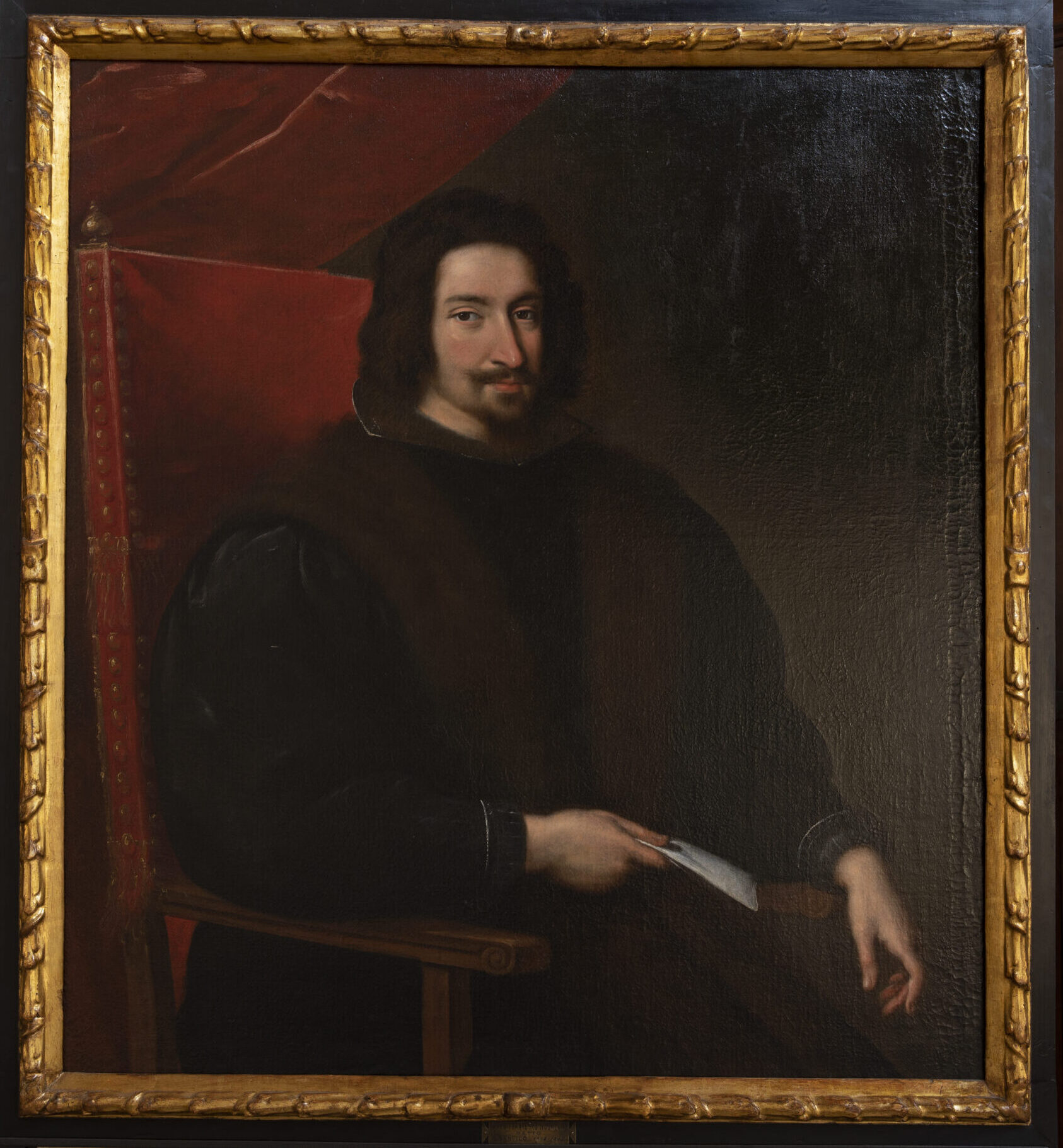
The Portrait of Count Bartolomeo III Arese (1610–1674), attributed to Carlo Francesco Nuvolone (1608/9–1661/2), dates to around 1650. The identical dimensions of the canvases and the matching frames in which they are set suggest the couple’s intention to have the two portraits displayed as a pair. Although not mentioned in the inventories of the Palazzo Arese Borromeo collection, they were most likely housed in the family’s Milanese residence on Corso di Porta Vercellina (today Palazzo Litta on Corso Magenta).
Bartolomeo III Arese, descendant of an ancient and noble family of officials and jurists, was a central figure in Lombard political affairs of the seventeenth century. His cursus honorum was swift and distinguished: appointed Capitano di giustizia in 1636, then questore of the Magistrato ordinario in 1638, senator and president of the same body in 1641, honorary regent of the Consiglio d’Italia from 1649, and finally, in 1660, president of the Senate of Milan—a position he held until his death. Bartolomeo was a man of great culture and a significant art patron as well as a politician and jurist, commissioning for his palace in Cesano a meaningful decorative program that reflected the values of the Arese lineage.
No record of the painting appears in the inventories: purchased by the Borromeo family in the immediate postwar period, it later entered the art market. Currently on permanent display at Palazzo Arese Borromeo, it was loaned to the Municipality of Cesano Maderno by its owner.
In the portrait of Bartolomeo, the extraordinary softness of modeling and the meticulous attention to the face capture and convey the subject’s strong and resolute character. His intense gaze, directed at the viewer, is stern yet benevolent, caught in a moment of stillness. He is depicted seated, in half-length, in a three-quarter pose. Equal care is evident in the pictorial rendering of his hands, anatomically precise but without expressive or defined gestures: in his right hand, he holds a letter—a typical attribute of the President’s political and administrative activities. The Count wears an elegant black robe, a symbol of the jurist and man of law, adorned with a rich fur collar. Against the dark background, in the upper right, the drapery of a red curtain serves as a backdrop.